Skip to content
Veravix

Veravix

Essential Steps to Create Your Website

  • Home
  • About
  • Privacy Policy
  • Terms and Conditions
  • Disclosure
  • Cookie Policy (EU)
  • Contact

WordPress Performance

WordPress Performance covers the technical changes that affect how fast a site loads and how efficiently it delivers content — caching, image optimisation, lazy loading, GZIP compression, database cleanup, CDN setup, browser caching, converting images to WebP, HTTP security headers, and using tools like Google PageSpeed Insights to find the actual bottleneck rather than guessing at one.

Page speed affects both search rankings and visitor behaviour in ways that are easy to measure and hard to ignore. Visitors abandon slow pages before they’ve read anything, and speed is something Google weighs on both desktop and mobile. The performance issues that affect most WordPress sites aren’t obscure — they’re the predictable result of skipping a handful of well-understood configuration steps.

The articles here focus on changes that make a genuine difference on a typical WordPress install, without needing server administration skills or a developer working at the infrastructure level.

How to Fix Cumulative Layout Shift in WordPress

July 13, 2026 by Etienne Basson
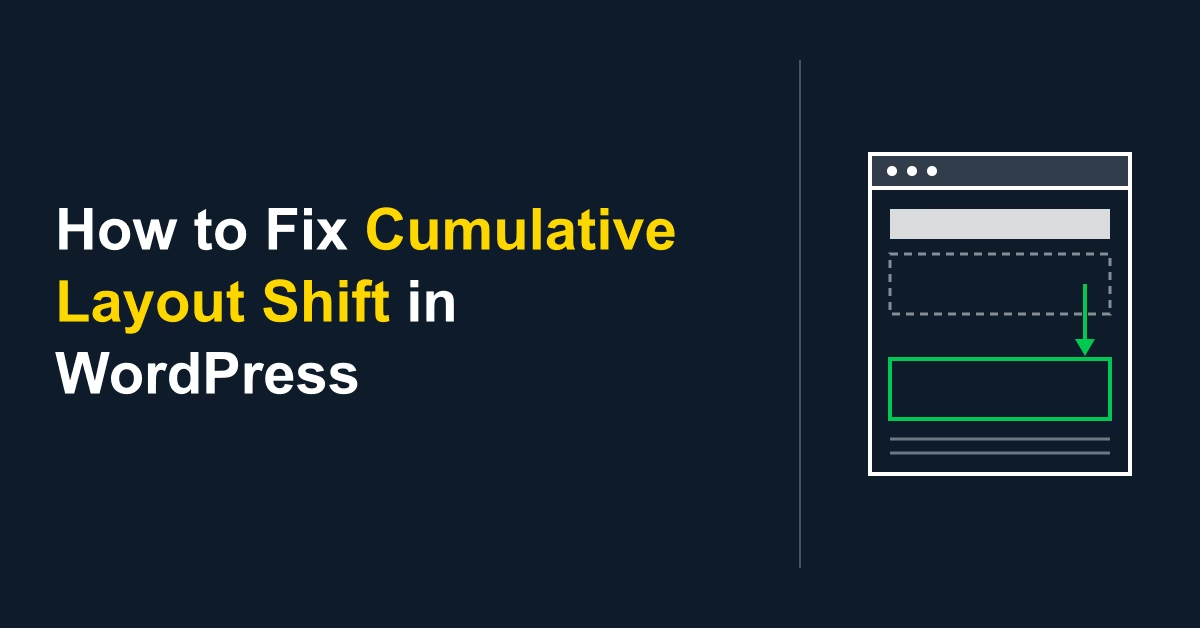
Diagram showing a page element shifting from its original dashed position down to a new solid position, illustrating cumulative layout shift

Learn why WordPress pages jump around while loading and how to fix Cumulative Layout Shift by reserving space for images, ads, embeds, and web fonts.

Categories WordPress Performance

How to Set Up Object Caching in WordPress for Faster Performance

July 9, 2026 by Etienne Basson
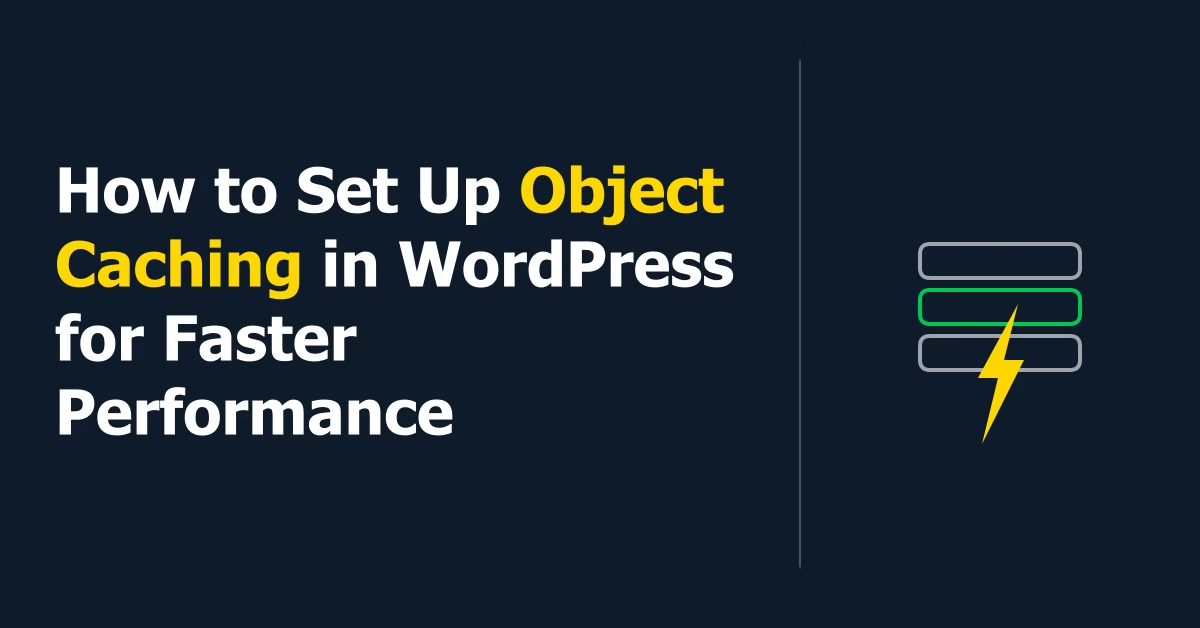
Diagram showing object caching layers with a lightning bolt representing faster WordPress performance

Object caching stores database query results in memory so WordPress can skip repeat queries. Here is how to check host support, install a Redis object cache plugin, and verify it is working.

Categories WordPress Performance

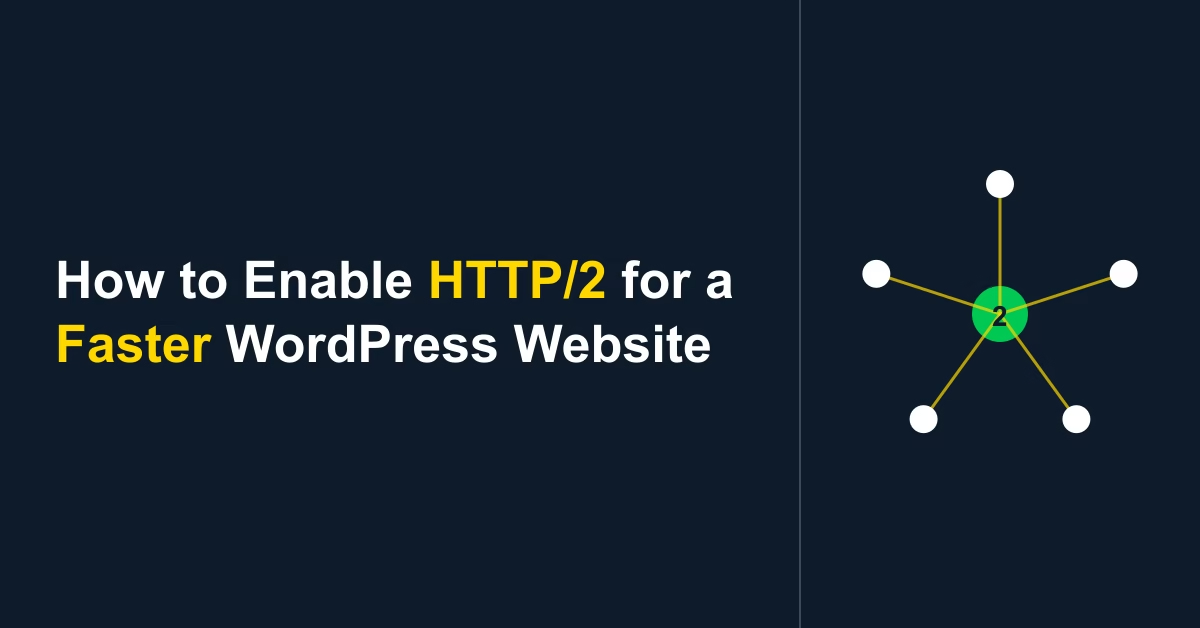
How to Enable HTTP/2 for a Faster WordPress Website

July 7, 2026 by Etienne Basson
Illustration of a central server node connected to five client nodes representing HTTP/2 multiplexed connections

HTTP/2 lets browsers load your WordPress site’s files in parallel over a single connection instead of queuing them one by one. Here’s how to check if it’s already on and turn it on if it isn’t.

Categories WordPress Performance

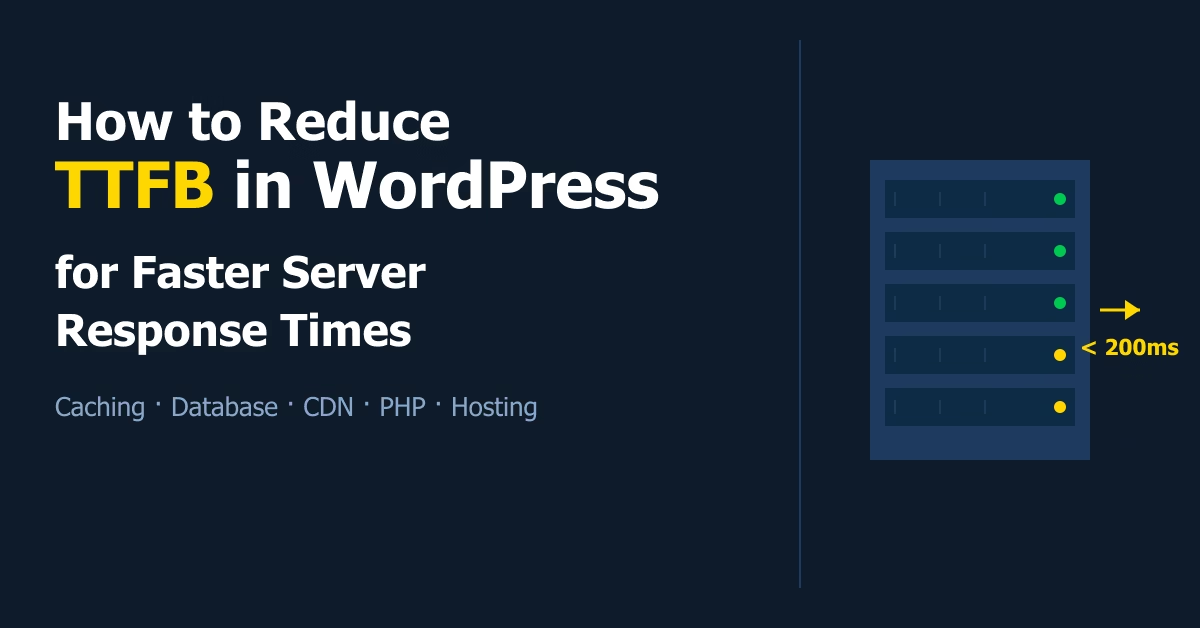
How to Reduce TTFB in WordPress for Faster Server Response Times

July 3, 2026 by Etienne Basson
How to reduce TTFB in WordPress — server rack icon with speed indicator

TTFB (Time to First Byte) is the server response time metric in Google PageSpeed Insights and Core Web Vitals. Learn how to reduce TTFB in WordPress using caching, database optimisation, CDN, and PHP upgrades.

Categories WordPress Performance

How to Set Up a WordPress Caching Plugin for Beginners

July 3, 2026June 29, 2026 by Etienne Basson
How to set up a WordPress caching plugin for beginners — speedometer showing faster loading

Learn how to set up a WordPress caching plugin step by step. This beginner guide covers choosing the right plugin, enabling page caching, and confirming it works.

Categories WordPress Performance

How to Remove Render-Blocking Resources in WordPress

June 26, 2026 by Etienne Basson
How to Remove Render-Blocking Resources in WordPress

Render-blocking resources delay the first paint on your WordPress site. Here’s how to identify them using PageSpeed Insights and fix them with JavaScript deferral, critical CSS extraction, and a performance plugin.

Categories WordPress Performance

How to Minify CSS and JavaScript in WordPress

June 24, 2026 by Etienne Basson
How to minify CSS and JavaScript in WordPress to improve page speed

Unminified CSS and JavaScript add unnecessary weight to every page load. This guide covers how to minify and combine scripts in WordPress using Autoptimize or LiteSpeed Cache, with tips on avoiding the common mistake that breaks your site.

Categories WordPress Performance

How to Set Up a CDN for WordPress to Speed Up Your Website

July 9, 2026June 22, 2026 by Etienne Basson
How to set up a CDN for WordPress to speed up your website

A CDN speeds up your WordPress site by serving static files from servers closest to your visitors. Here’s how to set one up using BunnyCDN and what to pair it with.

Categories WordPress Performance

How to Improve Core Web Vitals in WordPress

July 13, 2026June 18, 2026 by Etienne Basson

Learn how to improve Core Web Vitals in WordPress by fixing LCP, CLS, and INP. Covers image optimisation, lazy loading, caching, and reducing JavaScript.

Categories WordPress Performance

How to Enable Browser Caching in WordPress (Without a Plugin)

June 29, 2026June 16, 2026 by Etienne Basson
How to enable browser caching in WordPress using LiteSpeed Cache or .htaccess

Browser caching speeds up your WordPress website by storing static files on visitors’ devices after their first visit. This guide shows you how to enable it using LiteSpeed Cache or by editing your .htaccess file directly.

Categories WordPress Performance
Older posts
Page1 Page2 Next →

Categories

  • Artificial Intelligence (12)
  • Content Strategy (12)
  • Ecommerce (27)
  • Freelancing (12)
  • SEO (40)
  • Web Hosting (12)
  • Website Analytics (12)
  • Website Design (13)
  • Website Marketing (21)
  • Website Monetisation (12)
  • Website Security (13)
  • Website Structure (24)
  • WordPress Maintenance (12)
  • WordPress Performance (13)
  • WordPress Setup (53)

Latest Posts

  • A folder with organised documents illustrating a WordPress resource library
    How to Create a Resource Library in WordPress for Lead GenerationJuly 13, 2026
    Learn how to build a resource library in WordPress that organises your downloads and guides in one place and turns browsing visitors into email subscribers.
  • Diagram showing a page element shifting from its original dashed position down to a new solid position, illustrating cumulative layout shift
    How to Fix Cumulative Layout Shift in WordPressJuly 13, 2026
    Learn why WordPress pages jump around while loading and how to fix Cumulative Layout Shift by reserving space for images, ads, embeds, and web fonts.
  • Illustration for how to create a sales page in WordPress
    How to Create a Sales Page in WordPress for BeginnersJuly 13, 2026
    A sales page has one job: get the reader to buy. Here's how to build one in WordPress that's structured to convert, not just look good.
  • Illustration for how to set up two-factor authentication in WordPress
    How to Set Up Two-Factor Authentication in WordPressJuly 13, 2026
    A stolen or guessed password is often all it takes to break into a WordPress site. Here's how to add two-factor authentication so a password alone is never enough.
  • Illustration of an automated welcome email sequence with an envelope and automation loop icon
    How to Create a Welcome Email Sequence in WordPress for BeginnersJuly 12, 2026
    Set up a simple automated welcome email sequence in WordPress that introduces your business, delivers on your signup promise, and builds trust with new subscribers from the first email.
  • Illustration comparing hourly and project-based freelance pricing with a balance scale icon
    How to Set Your Freelance Rates: Hourly vs Project-Based PricingJuly 12, 2026
    Learn when to bill hourly versus quote a project fee as a freelance web designer, with a step-by-step process for setting rates that protect your income.
  • Illustration for an article about creating a thank you page in WordPress
    How to Create a Thank You Page in WordPress for BeginnersJuly 12, 2026
    A thank you page confirms the action worked, guides the visitor to a next step, and gives you a reliable URL to track conversions against. Here's how to set one up properly in WordPress.
  • Illustration for an article about using AI to write alt text for WordPress images
    How to Use AI to Write Alt Text for WordPress ImagesJuly 12, 2026
    AI can draft alt text for every image in your WordPress media library in seconds — but the output needs a careful edit before it's ready to publish. Here's a practical workflow for using AI to speed up accessible, accurate image descriptions.
  • How to Create a Lead Capture Funnel in WordPress for Beginners
    How to Create a Lead Capture Funnel in WordPress for BeginnersJuly 11, 2026
    Build a WordPress lead capture funnel step by step: a lead magnet, landing page, signup form, thank you page, follow-up emails, and conversion tracking.
  • How to Set Up SSH Access to Your WordPress Hosting
    How to Set Up SSH Access to Your WordPress HostingJuly 11, 2026
    Learn how to enable SSH on your WordPress hosting account, generate an SSH key pair, and use command-line access for faster file management and WP-CLI.

Search

Quick Links

  • Home
  • About
  • Privacy Policy
  • Terms and Conditions
  • Disclosure
  • Cookie Policy (EU)
  • Contact
© 2026 Veravix • Built with GeneratePress
Manage your privacy

To provide the best experiences, we and our partners use technologies like cookies to store and/or access device information. Consenting to these technologies will allow us and our partners to process personal data such as browsing behavior or unique IDs on this site and show (non-) personalized ads. Not consenting or withdrawing consent, may adversely affect certain features and functions.

Click below to consent to the above or make granular choices. Your choices will be applied to this site only. You can change your settings at any time, including withdrawing your consent, by using the toggles on the Cookie Policy, or by clicking on the manage consent button at the bottom of the screen.

Functional Always active
The technical storage or access is strictly necessary for the legitimate purpose of enabling the use of a specific service explicitly requested by the subscriber or user, or for the sole purpose of carrying out the transmission of a communication over an electronic communications network.
Preferences
The technical storage or access is necessary for the legitimate purpose of storing preferences that are not requested by the subscriber or user.
Statistics
The technical storage or access that is used exclusively for statistical purposes. The technical storage or access that is used exclusively for anonymous statistical purposes. Without a subpoena, voluntary compliance on the part of your Internet Service Provider, or additional records from a third party, information stored or retrieved for this purpose alone cannot usually be used to identify you.
Marketing
The technical storage or access is required to create user profiles to send advertising, or to track the user on a website or across several websites for similar marketing purposes.
Statistics

Marketing

Features
Always active

Always active
  • Manage options
  • Manage services
  • Manage {vendor_count} vendors
  • Read more about these purposes
Manage options
  • {title}
  • {title}
  • {title}